


AI Visibility: Why Your Business Needs to Show Up in AI Answers, Not Just Google
For years, getting your business found online followed a simple, reliable formula. Build pages, optimize for search engines, rank on Google, wait for clicks. If you did it well enough, and consistently enough, customers would eventually find you.
That model is breaking down faster than most businesses realize.
Your customers aren’t searching the way they used to. Instead of opening five tabs and scanning through links, they’re turning to AI tools like ChatGPT, Perplexity, and Google’s own AI Overviews to get a single, direct answer to their question. And the uncomfortable reality is this: if those AI systems don’t recognize, trust, or reference your business, you simply don’t exist in that conversation.
You could be ranking on page one of Google. You could have a polished website and a consistent posting schedule. None of it matters if AI doesn’t pick you.
This is what AI visibility actually means, and understanding it early might be the most important thing you do for your business this year.
The Numbers That Should Get Your Attention
Before we get into what AI visibility is and how it works, it’s worth grounding this in what’s actually happening.
Google’s dominance over search is eroding for the first time in a decade. Its share of general information searches fell from 73% in February 2025 to 66.9% by August, its steepest six-month decline in years. Meanwhile, ChatGPT’s share of general search queries tripled over the same period, rising to 12.5%. Daily AI tool usage more than doubled, jumping from 14% of people in February 2025 to 29.2% by August.
The behavioral shift is real and it’s accelerating. Around 3 in 4 Americans now say they use AI tools for search at least weekly. And when AI Overviews appear at the top of a search result, organic click-through rates drop by 61%, from 1.76% down to 0.61%.
Here’s the flip side of that same study: brands that are cited in AI Overviews earn 35% more organic clicks and 91% more paid clicks.
That’s the gap. The businesses showing up inside AI answers are pulling ahead. Everyone else is competing for a shrinking pool of attention.
What AI Visibility Actually Is
AI visibility is the ability of your business to appear inside AI-generated answers, not as a link in a ranked list, but as a mentioned, cited, or recommended brand within the answer itself.
When someone asks ChatGPT or Google’s AI Mode “What’s the best digital marketing agency for small businesses?” the system doesn’t hand them ten blue links to scroll through.
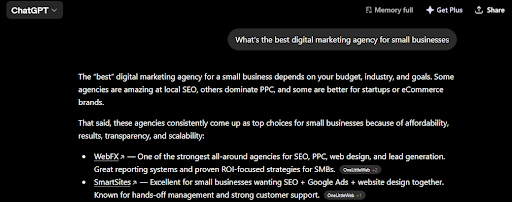
It assembles a direct, synthesized answer. Sometimes it names specific companies. Sometimes it pulls from a handful of sources and builds a recommendation. Either way, the decision about which businesses to include has already been made before the user sees anything.
That’s the part most businesses haven’t fully grasped: the selection happens before the click. You’re either in the conversation or you’re not.
This shift has even spawned its own discipline, Generative Engine Optimization, or GEO. Where traditional SEO focuses on ranking in search results, GEO focuses on being cited inside synthesized answers. The goal isn’t traffic from a ranked list. It’s being the source that AI engines choose to reference when answering the questions your customers are already asking.
Why the Old SEO Playbook Isn’t Enough
Traditional SEO is far from dead. Google still processes an estimated 16.4 billion searches per day. The rankings you’ve built still matter. And here’s something most people miss: strong traditional SEO actually supports AI visibility, because the content foundation you build for Google becomes the source material AI systems draw from.
But the problem is relying on SEO alone.
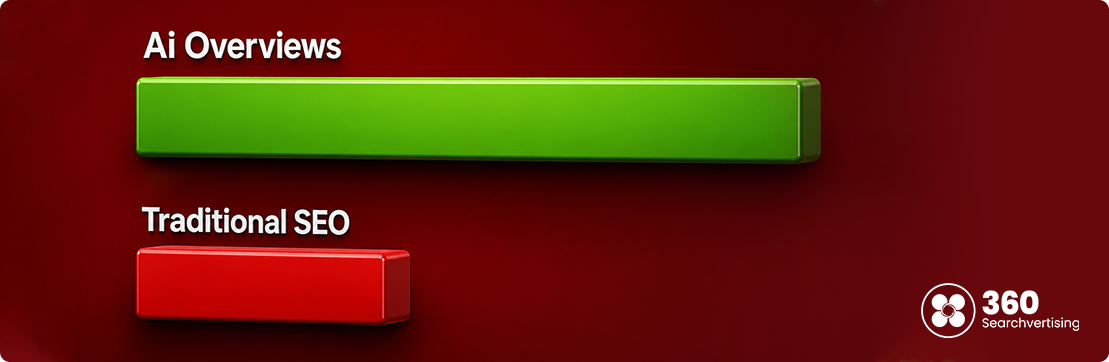
AI Overviews now appear at the top of roughly 60% of Google search results in the United States. When a user asks a question and an AI summary appears, many of them stop there, they got their answer without clicking anything. The volume of traditional search hasn’t collapsed, but the behavior around it has changed enough that visibility in search results alone is no longer equivalent to being found.
On top of that, AI search platforms like ChatGPT, Perplexity, and Claude operate on different logic than Google’s ranking algorithm.These systems are pulling from a much wider pool, and they’re selecting based on signals that aren’t fully captured by a traditional keyword-ranking approach.
The question businesses need to ask isn’t “how do I rank?” It’s “how do I get cited?”
How AI Actually Decides Which Businesses to Mention
AI systems don’t randomly recommend businesses. They follow patterns, and those patterns are reasonably well understood at this point. Here’s what drives the decision:
Clear, consistent positioning. AI needs to quickly understand what your business is known for. If your messaging is vague, inconsistent, or spread too thin across too many topics, it becomes harder for AI to confidently associate you with a specific problem or category. When descriptions of your business conflict across different sources, the result is often a hedged or absent mention in AI-generated responses. Businesses with sharp, consistent positioning in a defined niche show up far more reliably.
Content that answers questions directly. AI systems don’t read content the way a human does. They extract answers. Content that leads with direct claims, is clearly structured, and directly addresses real questions performs far better in AI citations than content that buries its point in long preambles. This is not about writing for robots. It’s about writing clearly. Concrete explanations, supporting evidence, and examples give AI something tangible to work with.
Topical authority and depth. One good article isn’t enough. AI systems favor sources that consistently cover a subject from multiple angles, demonstrating that a brand genuinely understands its domain. A cluster of related, in-depth content is a much stronger signal than a single well-optimized page. AI trusts specialists more than generalists.
Third-party mentions and credibility. What others say about your business carries more weight than what you say about yourself. Organic media mentions in reputable publications have been found to be one of the most effective GEO strategies, as AI engines tend to favor third-party, independent sources over brand-owned content. Organic mentions, community discussions, guest content, and genuine reviews all act as validation signals.
E-E-A-T signals. Google’s concept of Experience, Expertise, Authoritativeness, and Trustworthiness remains central to how AI systems evaluate content. Transparent author credentials, citations from reputable sources, and regularly updated material all contribute to whether AI considers your content worth referencing. Generic or unsupported content, no matter how well-written, gets passed over.
Presence on AI-cited platforms. This one surprises people. Reddit, LinkedIn, and YouTube were among the most cited sources by major AI platforms in late 2025. When your brand creates substantive content on these platforms, you give AI systems more source material to draw from.
The Shift in What “Being Found” Means
The framework that governed online visibility for the past two decades was essentially this: be present, rank well, get clicks. Visibility was a function of position.
What’s emerging now is different. Visibility increasingly means being the business that AI systems choose to mention when someone asks a question that leads to a buying decision. It’s less about position and more about recognition, whether AI has enough signals about your business to confidently include you in an answer.
The businesses that adapt to this shift early are the ones building those signals now, while the competitive landscape is still relatively open. AI-referred traffic is still a fraction of total search traffic, but it’s growing fast. AI-referred sessions jumped 527% year-over-year in the first half of 2025. And the quality of that traffic is notably higher. AI referrals convert at roughly 11.4%, compared to 5.3% for traditional organic search.
That gap in conversion quality is worth sitting with. When someone arrives at your business from an AI recommendation, they’ve already received an answer that likely positioned you as a credible option. They’re arriving with more context and more trust than someone who clicked a link in a list. The volume of AI traffic is smaller today, but the intent behind it is stronger.
This Isn’t About Replacing SEO. It’s About Evolving It.
The businesses that will win AI visibility aren’t the ones who abandon traditional SEO. They’re the ones who build on it intelligently.
The content you create for Google rankings provides the foundation that AI systems cite. The technical infrastructure that helps Google’s crawlers understand your site also helps AI understand what you do. The authority you build through backlinks and third-party mentions signals credibility to both.
What changes is the layer on top. Content needs to be structured so AI can extract clean answers, not just rank for keywords. Positioning needs to be consistent across every platform, not just your website. Authority needs to extend beyond your own domain, into the conversations and publications where AI systems look for validation.
The gap between businesses that grasp this and those that don’t is already visible. Some brands are becoming the default recommendations inside AI answers. Others are chasing rankings, unaware that a meaningful share of visibility has already moved somewhere they’re not optimizing for.
The longer this goes unnoticed, the harder it becomes to catch up, because being recognized by AI isn’t just about what you publish today. It’s about the cumulative body of signals you’ve built over time.
What to Do With This
If you’ve read this far, you likely already sense that something is shifting in how your customers find information. The question is what to do with that.
- Start by auditing your positioning. Is it clear and consistent everywhere your business exists online, your website, your social profiles, your directory listings? Does it clearly signal what specific problem you solve for which specific kind of customer?
- Then look at your content. Are you actually answering the questions your customers are asking AI tools right now? Not optimizing for keywords, but answering real questions with direct, structured, well-supported responses?
- Then think beyond your own platforms. Where is your business being talked about by others? Where could it be? The third-party validation signal is one of the most powerful levers in AI visibility, and it’s one most businesses aren’t actively building.
AI visibility isn’t a trick or a hack. It’s the outcome of making your business genuinely clear, credible, and recognizable, both on your own website and across the wider web that AI systems draw from. The businesses that put that work in now will be the ones that appear in the answers. The ones that don’t will slowly find themselves outside the conversation entirely.
The shift toward AI-driven discovery is already underway. Whether your business is part of that conversation, or invisible in it, is something you can still influence. But the window for being an early mover is narrowing.